


Osteoarthritis of the knee joint (also called gonarthrosis) is damage to the knee joint, as a result of which the articular cartilage is destroyed, the knee is deformed and the movements of the knee are restricted.The article will help you find out about the symptoms and start the necessary treatment in a timely manner.
Osteoarthritis of the knee joint
Experts divide gonarthrosis into primary and secondary forms:
- The cause of the primary form is a congenital defect of the joint and the period of development of the disease is in childhood and adolescence.
- The secondary form can develop at any age.
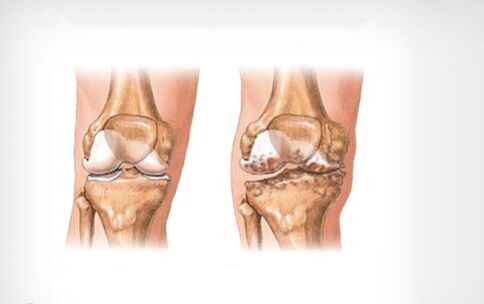
Experts name the main causes of the disease:
- bad posture;
- being overweight;
- different types of knee joint injuries;
- Disorders of mineral metabolism and metabolism;
- the presence of endocrine diseases;
- increased load on the knee joints;
- disturbed calcium metabolism due to taking hormone-containing medications;
- operations to remove the meniscus;
- presence of arthritis;
- weak ligaments;
- Menopause and menopause in women.
Osteoarthritis of the knee joints can occur on both sides or on one side.
Stages of osteoarthritis and their symptoms
Depending on the symptoms and approach to the disease, experts divide the disease into 3 stages.
Initial or 1st stage of osteoarthritis
At this stage, mild pain occurs with increased stress on the knee.The initial phase can last between a year and several years.To prevent the stage from developing into a more severe form, a number of measures should be taken aimed at restoring deformed cartilage, strengthening ligaments and restoring mobility in the knee.
At this stage, timely treatment allows you to completely eliminate the pathology.But most patients ignore the symptom in the form of mild pain and therefore do not seek medical attention.Osteoarthritis of the knee joint is treated by an orthopedist, rheumatologist or surgeon.
Middle or 2nd stage of osteoarthritis
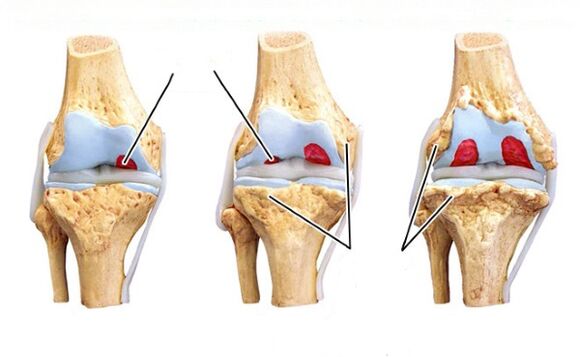
At this stage, the symptoms of the disease become more obvious and therefore cannot be ignored.Doctors point out that most patients seek medical help in stage 2.At this stage, an accurate diagnosis can be made.Timely treatment can stop the progression of the disease to stage 3.
Serious symptoms include:
- sore knees due to hypothermia;
- Presence of a gentle crunch;
- swelling or swelling of the knee joints;
- severe knee pain when climbing stairs or other forms of increased stress;
- pain and tingling in the calves;
- Stiffness when bending and extending the knee.
The final or third stage of osteoarthritis
At this stage, the consequences of the disease are irreversible and it is impossible to stop the development of pathology.However, the treatment will alleviate the patient's condition for a while.You should never ignore symptoms or self-medicate, as this may result in a change in gait, walking with a cane, or disability.
In addition to the above, doctors consider the main symptoms of stage 3:
- Pathologies of the endocrine system (thyroid problems, diabetes);
- hereditary and age-related factors.
Diagnostic methods
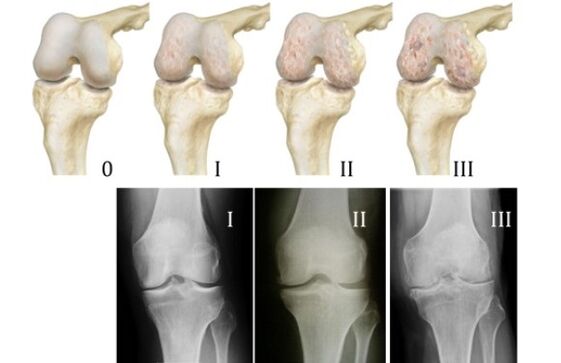
The specialist makes a diagnosis based on the patient's medical history and the results of laboratory and instrumental studies.
Laboratory tests include:
- general blood test.The study allows you to identify the causative agent of the disease and assess the degree of inflammation.
- general urine testallows you to identify or exclude the autoimmune origin of the disease and assess whether the cause of the pathology lies in the kidneys and urinary tract.
- biochemical blood test, which is divided into many others, the indicators of almost all studies are outside the normal range.
Laboratory tests are carried out during the exacerbation of the disease, since during remission all indicators are within the normal range.
Instrumental studies include:
- Radiography.It is performed in two projections – postero-anterior and lateral.In order to compare the diseased and the healthy knee, the doctor usually takes an X-ray of both knees.
- Arthroscopy.This procedure should be understood not only as a study, but also as a mini-surgery.The fact is that through a small hole in the knee, the doctor inserts a small LED conductor and displays on the computer screen a complete picture of the internal state of the knee;The resulting tissue fragments are sent to the laboratory if a cartilaginous or malignant tumor is suspected.During operations, the shape of the menisci can be corrected endoscopically and polyps and chondrophytes can be removed.In addition to diagnosing osteoarthritis, other diseases can also be carried out and examined, as the knee joint is a large organ and you can get a complete picture of the body's condition.
- Ultrasonic (ultrasound examination).This examination method has two important advantages over X-rays: it is harmless and, thanks to its comprehensive visualization options, it helps to see the soft tissues of the joint.
- CT (computed tomography).The examination is an improved form of radiography, as in this procedure the doctor takes several images and thanks to them creates a three-dimensional image of the affected organ on the computer.This form is used less often than others due to the time required and the large amount of radiation.
- MRI (magnetic resonance imaging).Unlike the previous method, it is more harmless.MRI also allows you to get a better image of the soft tissues compared to CT.However, MRI is used just as rarely as CT because its use requires high material costs and cannot be used on patients whose bodies are over metal objects (knitting needles, crowns).CT and MRI are contraindicated in people weighing more than 120 kg.
 scintigraphy.Expensive and radiation-intensive method.Therefore, it is used in cases where cheaper methods are ineffective.In this study, a substance is introduced into the patient's body that reacts to the diseased organ and localizes around it.
- tomographyThe study is based on heat radiation from the body surface.Typically, the affected organ manifests itself in the form of lesions with an increased temperature.A tomograph is a bulky instrument and the procedure is expensive, so this study is carried out only in large clinics.
Medicines to treat and relieve symptoms
Experts point out that treatment cannot begin without relieving pain and eliminating inflammation.Therefore, doctors prescribe various non-steroidal (i.e. non-hormonal) medications.However, you cannot take them longer than prescribed because this group of drugs does not treat the disease but rather relieves symptoms as the disease progresses.
Ointments for osteoarthritis
Treatment of osteoarthritis of the knee joint when symptoms such as swelling and pain are present is rarely possible without ointments.
In contrast to other forms of drug release, this group has clear advantages:
- quickly relieves pain and inflammation;
- Because it is easy to use, it can be easily combined with other treatment methods such as physiotherapy.
- There are no negative effects on the liver.
Many years of experience in the treatment of arthrosis and studies with positive patient reviews have made it possible to identify a number of effective ointments that have a warming vasodilator effect.They contain red pepper extract, bee and snake venom.
Gymnastics for osteoarthritis

Gymnastics is one of the important methods of treating arthrosis of the knee joint, which should be used during the remission period after the elimination of pain symptoms.
It promotes:
- Improving Articular Cartilage Nutrition and Overall Health:
- pain reduction;
- strengthening the muscles and ligaments of the knee joint;
- Increasing joint mobility.
To see the positive effect,You need to train daily or every other day, increasing the load to 30 minutes per workout.
- Warm up.You need to walk on tiptoes or heels for 3-5 minutes.
- Pedal an imaginary bike 20-30 times (10-15 times with each leg).
- Lie on your stomach and bend and straighten your knees 10-15 times.Hold the leg in this position for 5 seconds each time you bend it.
- Extend your legs while lying on your back.Lift your leg and bend your knee.The heel should be parallel to the floor.
- Lie on your right side, lift your left leg, pull it towards your stomach, and then stretch it back as far as possible.Turn over to the other side and repeat the exercise.Repeat this 5-6 times for each leg.
Exercises should be avoided if:
- Hernia of the abdomen or thighs;
- cardiovascular diseases;
- infectious diseases;
- blood diseases;
- Rehabilitation period after operations.
Rubs and compresses
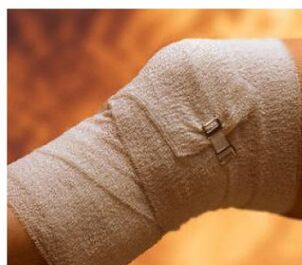
Various rubs and compresses are often used in the treatment of osteoarthritis.Their main advantages include the availability of ingredients and the absence of side effects.
- Garlic.Pour vegetable oil (200 ml) over 1 piece of vegetable, cover with a lid and leave in a dark and cool place for 7 days.Then wash off the product overnight.To eliminate a specific odor, cover the knee with a thick gauze bandage in the morning and rinse thoroughly with water.
- Egg.Mix vinegar with 1 egg yolk 1:1 and immediately rub some product into the knee.Apply 3 per week.After rubbing, wrap your knee with something warm.
- Honey.Mix 100 grams of honey and 3 grams of Mumiyo and rub it into the knee immediately.Wrap your knee.
- Cabbage.Soak a piece of woolen cloth in the juice of the vegetable and apply it to the knee.
- Oatmeal.Cook a normal porridge from 1-2 tablespoons of flakes in water.You can cook the flakes for no more than 7 minutes!Pour the thick product onto a clean cloth and apply to the knee.
Wraps
Osteoarthritis of the knee joint (symptoms and drug treatment are listed above), according to experts, can be cured with various types of wraps.Honey and herbs are the most effective.
According to research, honey wraps help:
- restore tissue and intra-articular cartilage destroyed by disease;
- eliminate pain and inflammation;
- burn excess cholesterol.
It is worth noting that honey is most effective when combined with cinnamon.
Herbal wraps have the above properties:
- bark of willow, oak, birch, aspen;
- roots of valerian, comfrey, burdock;
- leaves of hops, birch, nettle;
- herbs wild rosemary and St. John's wort;
- Chamomile flowers, marigold.
Treatment of arthrosis of the knee joint with hirudotherapy
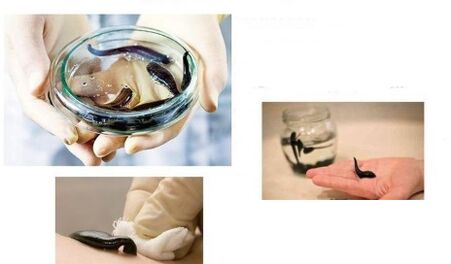
Hirudotherapy, i.e. treatment with leeches, is considered one of the most effective methods for treating osteoarthritis of the knee joint.It can be used at the first symptoms and must be prescribed by the attending physician and under the supervision of specialists.Before the first procedure, you should familiarize yourself with the contraindications.
You should not treat with leeches:
- children and the elderly;
- Patients suffering from reduced blood clotting, hypotension, severe fatigue, leukemia, anemia, gastrointestinal erosion, stomach ulcers, problems with the digestive system, cancer, tuberculosis, anemia and hemophilia;
- Women during pregnancy and breastfeeding.
In order for the treatment to be effective, 1-2 procedures should be carried out every 5-6 months.Treatment can be carried out more often or less often - it all depends on the stage of the disease.If after 1-3 sessions the patient feels improvement and does not experience any allergic reactions, treatment with leeches can be continued.
Otherwise, the patient is given a break of 9 months and if the allergy recurs or there is no improvement, the hirudotherapy sessions are stopped.During the treatment, the specialist treats the knee with an odorless product and then checks the suitability of the leeches to be used.
To do this, leeches are placed in a container with water.If the leeches stick to the walls, they can be used.The specialist places 2-6 leeches on the kneecap.
When sucking, leeches release a number of useful enzymes into the human body that help:
- restore and strengthen immunity;
- restoration of blood circulation and metabolic processes;
- Eliminate swelling and adhesions.
Hirudotherapy cannot be used as an independent treatment method.For greater effectiveness, experts recommend combining it with physiotherapy, physical therapy and medication.
Take a turpentine and pine bath
Last but not least, balneotherapy, i.e. taking various baths with therapeutic effects, is important for eliminating osteoarthritis symptoms.Experts point out that there are many different types of medicinal baths, but turpentine and pine baths have proven to be particularly effective.They can be taken not only in balneological health resorts, but also at home.
But despite their advantages, they should be abandoned:
- patients with heart disease;
- in the presence of cancer, tuberculosis, varicose veins, diabetes mellitus, epilepsy, arteriosclerosis, arterial hypertension,
- if the patient has suffered a heart attack or stroke;
- in the presence of skin diseases;
- pregnant women.
For a turpentine bath, you need to mix 10 grams of baby soap and 0.75 ml of salicylic acid and pour 500 ml of boiling water over the mixture.While the mixture cools, you need to fill the bathtub with hot water.When the mixture has cooled to 45 degrees, add turpentine and pour 15-20 ml of the mixture into the bath.
The presence of turpentine can cause the temperature in the bathroom to appear elevated.Therefore, you cannot increase the dose by more than 20 ml.The bath should be taken daily for 10 to 14 days, gradually increasing the dose of the turpentine mixture to 80 ml per treatment.After bathing, you need to rinse the mixture with warm water and put on warm clothes or lie under a blanket.
For pine baths you need pine needles or branches.About 25-30 branches will need to be broken into small pieces to fit in the pan.Before preparing the decoction, rinse the branches and remove any dirt, add water and boil for 5-10 minutes.Strain the finished broth and pour it into a bath of hot water.
You need to take a bath for 10-15 minutes.You should then dry yourself off and put on warm clothing.It is not recommended to do physical work and put strain on your knees.A treatment with pine baths can include 7-12 applications, which can be carried out every two days or daily.After six months the course can be repeated.This procedure extends the duration of remission and stops the progression of the disease.
Use of chondroprotectors
Osteoarthritis of the knee joint (symptoms and treatment with folk remedies are listed below) cannot be cured without chondroprotectors - a group of drugs aimed at restoring cartilage tissue and its nutrition.All drugs in this group are divided into 5 groups.Medicines intended for the treatment of osteoarthritis belong to group 4.
They are based on:
- glucosamine;
- chondroitin sulfate;
- avocado and soy extracts;
- hyaluronate and hyaluronic acid;
- Synthesis of glucosamine and chondroitin sulfate.
Chondroprotectors are prescribed by specialists along with painkillers.However, unlike the latter, the former must be taken for life, as only in this case can the development of osteoarthritis be slowed down and disability stopped.The effect of taking chondroprotectors is visible only after 2-8 days.
The medications are available in the form of gels, ointments, tablets and injections.An injection of a solution is given into the knee.
Diet: what foods are allowed, dietary rules and approximate diet

Being overweight has a negative effect on the development of osteoarthritis - the disease progresses faster than in patients with a normal weight.Therefore, people who are overweight are recommended to lose extra pounds.But at the same time, it is strictly forbidden to starve or follow mono-diets or diets with diets with dietary restrictions.
Authorized products include:
- Cultured meat without hormones that can be boiled, baked, steamed or stewed.If you do not have access to farm meat, you can buy regular meat, but you should remove the skin and fat, as this is where all the harmful substances fed or injected into animals or poultry accumulate.It is better to limit the consumption of this meat to 1-2 times a week, and eat vegetable or fish dishes the rest of the time.
- Fruits and vegetables that can be baked or steamed depending on your taste.
- all types of cereals (except instant cereals).
- Products with pectin: currants, fructose jelly;
- fermented milk products;
- eggs;
- Whole grain bread and pasta.
It is important to exclude from the diet:
- pastries, sweets and white bread;
- alcoholic beverages and beer;
- various types of fast food and snacks;
- Sausage and other types of prepared meat products.
If you have osteoarthritis, you need to consume 1200 calories a day.You need to eat fractionally, that is, in small portions every 2-3 hours.
Folk remedies
Osteoarthritis of the knee joint, symptoms and treatment can be easily carried out using conventional medicine:
- If the osteoarthritis is accompanied by swelling, a blue clay compress can help.To do this, you need to dilute the clay with water to a creamy consistency and place it on a thick cloth folded 4-6 times and apply to the joint.Wrap the knee with gauze or another cloth to prevent the compress from slipping off.Leave on for 2-3 hours and rinse with warm water.The fabric can be washed and reused.
- Experts recommend giving up natural tea and coffee and replacing them with decoctions and infusions.For example, a decoction of cranberries.For him 2 tsp.Berries must be poured 1 liter.Boiling water and wrapped in a towel and let it rest for an hour.You need to drink 3-4 times a day.
- Massage ointment helps to relieve pain and inflammation at any stage of the disease.To do this, you need to mix 50 grams of petroleum jelly with 10 grams of ground hops, sweet clover and St. John's wort.You need to let the product brew in a dark place for 2-3 hours.Massage in with light massage movements.You can wrap your knee.
How long does the rehabilitation phase last?
It is not possible to say with certainty how long osteoarthritis rehabilitation will take, as the timing depends on various factors.For example, the patient's age and lifestyle, the degree and severity of the disease.
In general, the recovery period lasts 1-2 months, during which, with the help of specialists, the patient:
- eliminates inflammatory and pain syndromes;
- learns physical exercises and adjusts diet.
In order for the remission phase to last as long as possible, the patient must exercise regularly and see a doctor.Osteoarthritis of the knee joint, with the elimination of symptoms and proper treatment, allows you not to leave your usual rhythm of life.